This article was medically authored by Dr. William Fox and last reviewed for accuracy on 11/16/2026.
If you are bleeding heavily after giving birth, call 911 or go to the nearest emergency department now. Do not wait for a clinic appointment, and do not come to a Texas Endovascular office for this. Severe postpartum bleeding is treated in a hospital.
When bleeding continues after first-line obstetric care, hospital teams may call an interventional radiologist for uterine artery embolization, or UAE. The procedure can slow or stop the bleeding and, in many cases, avoid an emergency hysterectomy. A 2026 hospital study of 150 patients is a recent look at how often that approach works, and when it does not.
Postpartum hemorrhage is excessive bleeding after a vaginal or cesarean birth. It may start right away or, less often, later on. A common cause is uterine atony, when the uterus does not contract firmly after delivery. Other causes can include retained placenta, tears, or problems with the placenta or clotting.
This is a medical emergency. Call 911 or go to the nearest emergency department if you are soaking through one or more pads in an hour, pass clots bigger than an egg or pass tissue, feel dizzy or faint, have trouble breathing, or have a fast-beating heart. These match the CDC Hear Her urgent maternal warning signs: https://www.cdc.gov/hearher/maternal-warning-signs/index.html.
Do not come to an outpatient clinic for this. UAE is not the first treatment. It is considered when bleeding continues and a uterus-sparing option is appropriate. A hysterectomy is still sometimes needed.
An interventional radiologist uses real-time imaging to guide a thin catheter to the uterine arteries and reduce blood flow to the bleeding uterus, aiming to stop the hemorrhage and leave the uterus in place.
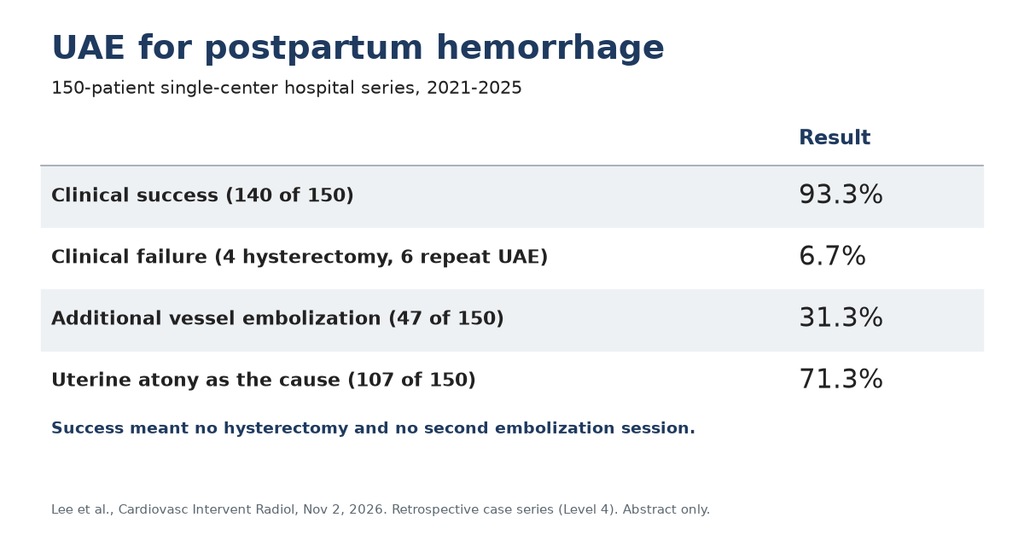
In the 2026 study, the uterine arteries alone were not always enough. In 47 of 150 patients (31.3%), the team also embolized additional pelvic vessels. That is a hospital decision based on the angiogram, and one reason this procedure is done in an acute-care setting, not during an office visit for fibroids.
No. Both use a catheter to reduce uterine artery blood flow, but they are not the same treatment visit.
A study of emergency postpartum care should not be read as a result for elective fibroid treatment, or the other way around.
Lee and colleagues reviewed 150 consecutive patients who underwent UAE for postpartum hemorrhage at one tertiary hospital in Busan, Republic of Korea, from 2021 to 2025. The paper appeared online in Cardiovascular and Interventional Radiology on November 2, 2026. It is a retrospective case series, which the authors graded as Level 4 evidence, not a randomized trial. The figures below come from the published abstract. The full paper is not open access, so technique details, later pregnancy, and fertility outcomes are not summarized here.
The authors defined clinical failure as a hysterectomy or a second embolization session. Clinical success meant the patient had neither of those.
In an exploratory look at cesarean births, failure was more common after an emergency cesarean (5 of 32, 15.6%) than after an elective cesarean (1 of 56, 1.8%). Those counts are small and should be read cautiously.
On a simple (univariable) analysis, a higher total red-cell transfusion and a lower platelet count were associated with clinical failure. Transfusion given before UAE was not. The authors suggested that total transfusion reflected how severe the hemorrhage was, and they reported that procedural variables were not associated with failure. These associations should not be treated as independent predictors. The findings come from one center abroad. They are not Texas Endovascular results, and they are not a promise of what will happen in every hospital or every patient.
No. Texas Endovascular does not offer postpartum or emergency obstetric care. If you are bleeding heavily after childbirth, call 911 or go to the nearest emergency department.
Our board-certified interventional radiologists do perform uterine fibroid embolization at clinics in Greater Houston and Dallas-Fort Worth. If you have been told you may need a hysterectomy for fibroids and want to ask about a uterus-sparing option, that is a non-emergency clinic conversation. Related questions about adenomyosis sometimes come up at that visit as well.
It is an image-guided hospital procedure. An interventional radiologist uses a catheter to reduce blood flow through the uterine arteries, and sometimes other pelvic vessels, when severe bleeding after childbirth has not stopped with other treatment. The goal is to control the hemorrhage and, when possible, avoid an emergency hysterectomy.
In the 2026 hospital series, 140 of 150 patients (93.3%) did not have a hysterectomy and did not need a second embolization session. Four patients still had a hysterectomy, and six needed repeat embolization. UAE can be uterus-sparing, but it does not guarantee that a hysterectomy will be avoided.
They are related techniques used for different problems in different settings. Emergency UAE is hospital care for bleeding that has not responded to other treatment. UFE is an elective outpatient treatment for symptomatic fibroids. A result from one should not be applied to the other.
No. The practice does not offer postpartum care. For heavy bleeding after birth, call 911 or go to the nearest emergency department. Texas Endovascular does offer outpatient UFE for fibroids. Call 713-575-3686 to ask about a fibroid consultation.
Call 911 or go immediately if you have heavy bleeding (soaking through one or more pads in an hour), pass clots bigger than an egg or pass tissue, feel dizzy or faint, have trouble breathing, or have a fast-beating heart. See the CDC Hear Her urgent maternal warning signs: https://www.cdc.gov/hearher/maternal-warning-signs/index.html. Do not wait for an office appointment. This article cannot diagnose your symptoms or replace emergency care.
If you are in an emergency, stop here and get hospital care. If you are not in an emergency and want to talk about fibroids, adenomyosis, or whether UFE may be an option, call Texas Endovascular at (281) 690-5082 (Houston) or (469) 343-0265 (Dallas). We have clinics in Greater Houston and Dallas-Fort Worth. Our team can also help you understand appointment and insurance steps before a visit is scheduled.
This article is for education. It is not medical advice, a diagnosis, or a treatment offer for postpartum hemorrhage. Study figures are from the published abstract of a single-center retrospective series and may not apply to every patient or every hospital. Individual results vary. Texas Endovascular does not treat postpartum hemorrhage. For a medical emergency, call 911 or go to the nearest emergency department.
Lee S, Lee H, Kwon H, Kim CW, Kim CH, Kim SC. Cardiovasc Intervent Radiol. Published online November 2, 2026. doi:10.1007/s00270-026-04658-2. PMID: 42972066. https://pubmed.ncbi.nlm.nih.gov/42972066/
Scheduling
Please contact our dedicated specialists to schedule a consultation today.